

 English
  русский
  Español
  عربى
عربى Industry News
Home / News / Industry News / Tube Processing Equipment Guide: How to Choose, Use, and Maintain It Right

Content
Tube processing equipment refers to the machinery used to cut, bend, form, and finish metal or plastic tubing into parts ready for assembly. If you've ever wondered how a straight length of round or square tube becomes a car exhaust pipe, a bicycle frame, or a piece of furniture, the answer is almost always some combination of tube processing equipment working in sequence. This includes cutting saws, laser cutters, bending machines, end formers, and deburring stations. Each machine handles one step of the job, and together they turn raw stock into a finished, dimensionally accurate component.
For shop owners and buyers, understanding what each piece of equipment actually does is the first step toward building an efficient production line. Buying the wrong machine, or buying more capability than you need, wastes money and floor space. Buying too little capability slows down production and creates bottlenecks. This guide walks through the main categories of tube processing equipment, how to choose the right combination for your work, and how to keep the machines running well for years.
Most tube fabrication shops rely on a handful of core machine categories. Knowing what each one is built for makes it much easier to plan a production line or diagnose a bottleneck.
Cutting is usually the first operation. Depending on the material and tolerance needed, shops use cold saws, band saws, abrasive cutoff saws, or laser tube cutters. Laser cutting equipment has become popular because it can cut complex profiles, notches, and holes directly into the tube in one pass, reducing the need for secondary machining.
Bending equipment shapes straight tube into curves and angles. CNC tube benders offer repeatable, programmable bends for high-volume work, while manual or semi-automatic benders are common in smaller shops or for prototyping. The choice depends heavily on wall thickness, bend radius requirements, and how many identical parts need to be produced.
End forming machines flare, expand, reduce, or bead the ends of a tube so it can connect to another part, such as a hose fitting or a joint. This equipment is common in automotive, HVAC, and plumbing manufacturing, where a secure, leak-free connection matters.
After cutting or bending, tube edges often have burrs or sharp spots that need to be removed. Deburring machines, whether rotary, brush-style, or vibratory, clean up these edges so the part is safe to handle and ready for welding, coating, or assembly.
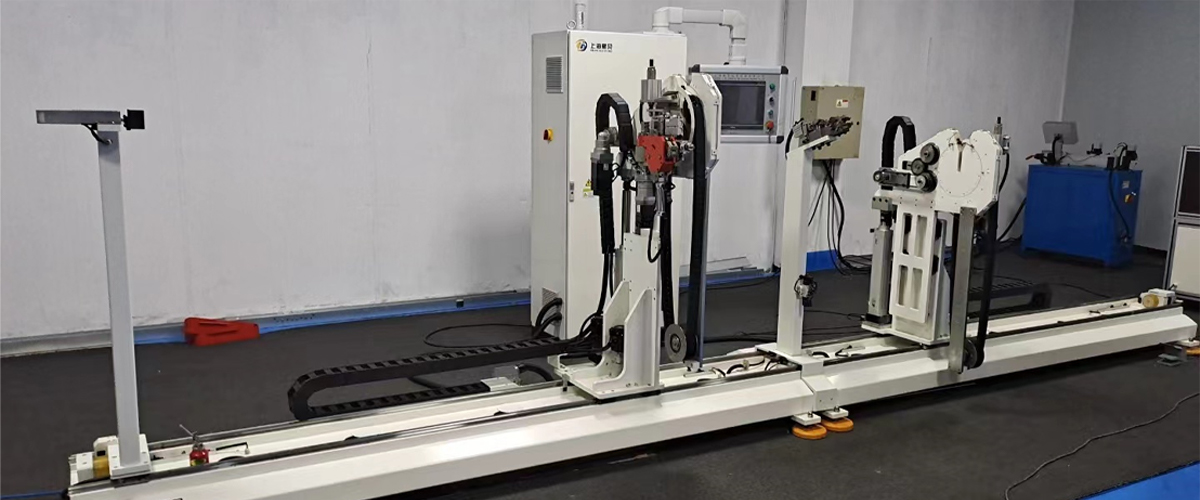
There's no single "best" machine — the right choice depends on your material, volume, and tolerance requirements. Before buying, it helps to answer a few practical questions.
Once you have clear answers, you can match machine specifications to your actual needs instead of over-buying capacity you'll rarely use. The table below gives a general sense of which equipment fits which production style.
| Production Style | Recommended Equipment | Why It Fits |
| Prototyping / low volume | Manual bender, band saw | Lower cost, flexible setup changes |
| Mid-volume, varied parts | Semi-automatic bender, cold saw | Balance of speed and flexibility |
| High-volume repeat parts | CNC bender, laser cutter | Consistent precision at speed |
| Complex end connections | Hydraulic end forming machine | Handles flaring, beading, reducing |
Tube processing equipment represents a significant capital investment, and how well it's maintained directly affects part quality and downtime. A machine that's out of calibration doesn't just slow production — it can produce out-of-spec parts that get scrapped further down the line.
Operators should inspect cutting blades or laser lenses for wear, check hydraulic fluid levels on bending machines, and clear metal shavings or debris from the work area. These few minutes at the start of a shift catch small problems before they become costly repairs.
Beyond daily checks, most manufacturers recommend a servicing schedule that includes lubrication of moving parts, tooling replacement at set intervals, and periodic recalibration of CNC controls. Keeping a simple maintenance log helps track when parts were last serviced and flags patterns, such as a bearing that keeps failing early, which might point to a deeper alignment issue.
Even experienced shops fall into a few predictable traps. Being aware of them ahead of time can save real money and headaches.
One frequent mistake is buying a machine based purely on price rather than matching it to actual material and tolerance requirements. A cheaper bender might struggle with thin-wall stainless tube, leading to wrinkling or ovality that ruins parts. Another common issue is underestimating training time — operators need real hands-on time with CNC programming and tooling changeovers before they can run a machine efficiently. Skipping this step often shows up later as slow cycle times or inconsistent quality.
Ignoring tooling costs is another trap. Dies, mandrels, and collets wear out and need replacing, and these ongoing costs should be factored into the total cost of ownership, not treated as an afterthought. Finally, many shops overlook the importance of matching machine throughput to the rest of the production line. A fast laser cutter feeding into a slow manual bending station just creates a pile of unfinished parts waiting at the bottleneck.
Choosing the right tube processing equipment comes down to understanding your material, your part complexity, and your production volume, then matching machinery to those realities rather than to marketing claims. A well-planned combination of cutting, bending, end forming, and finishing equipment, paired with consistent maintenance, will keep quality high and downtime low. Whether you're setting up a new shop or upgrading an existing line, taking the time to plan equipment selection carefully pays off in fewer scrapped parts, smoother workflows, and equipment that lasts for years.

 [email protected]
 +86-021-57678482
 +86-18001603006
 Building A, No. 299 Tangming Road, Shihudang Industrial Zone, Songjiang District, Shanghai, China
Copyright © Shanghai Fubei Electromechanical Equipment Co., Ltd. All Rights Reserved Automated Pipe Processing Equipment Factory
